The Etruscans and Etruscan history
A short guide to who the Etruscans were, how they lived and why Tarquinia is one of the best places to meet them.
Who were the Etruscans
The Etruscans were a civilisation of central Italy, between the Arno and the Tiber, in the area called Etruria (today Tuscany, northern Lazio and part of Umbria). Their story begins with the Villanovan culture, around the 9th century BC, and runs until gradual Romanisation, completed in the 1st century BC.
Their origin has long been debated: today scholars tend to see them as the result of a development in central Italy starting from the Villanovan culture, in contact with Greeks and Phoenicians.
The Etruscan cities
The Etruscans were not a single state but a network of independent city-states, often joined in a religious and political league. Among the most important were Tarquinia, Cerveteri (Caere), Vulci and Veii, in southern Etruria, close to Rome.
Tarquinia, Etruscan Tarchna
The city's Etruscan name was Tarchna (or Tarchuna), the Latin one Tarquinii. Tradition links it to the mythical Tarchon and to the Tarquin kings of Rome. In antiquity, it was one of the most powerful Etruscan cities and fought Rome for a long time, until Rome finally subdued it; its people received Roman citizenship in 90 BC.
The settlement stood on the Civita plateau, dominated by the Ara della Regina temple, which gave us the Winged Horses now in the National Archaeological Museum. Opposite, on the Monterozzi hill, lies the city of the dead: the Necropolis, a UNESCO site since 2004.
Painted tombs and the Etruscan view of death
The Etruscans built tombs as homes for the dead. In Tarquinia many chambers are frescoed with banquets, dances, games, hunting and fishing: scenes of life that give us the colours and gestures of a vanished people, more than objects alone can.
Language, writing and art
- Language: Etruscan used an alphabet derived from the Greek one. We can read it, but the vocabulary we know is limited and not everything is clear yet.
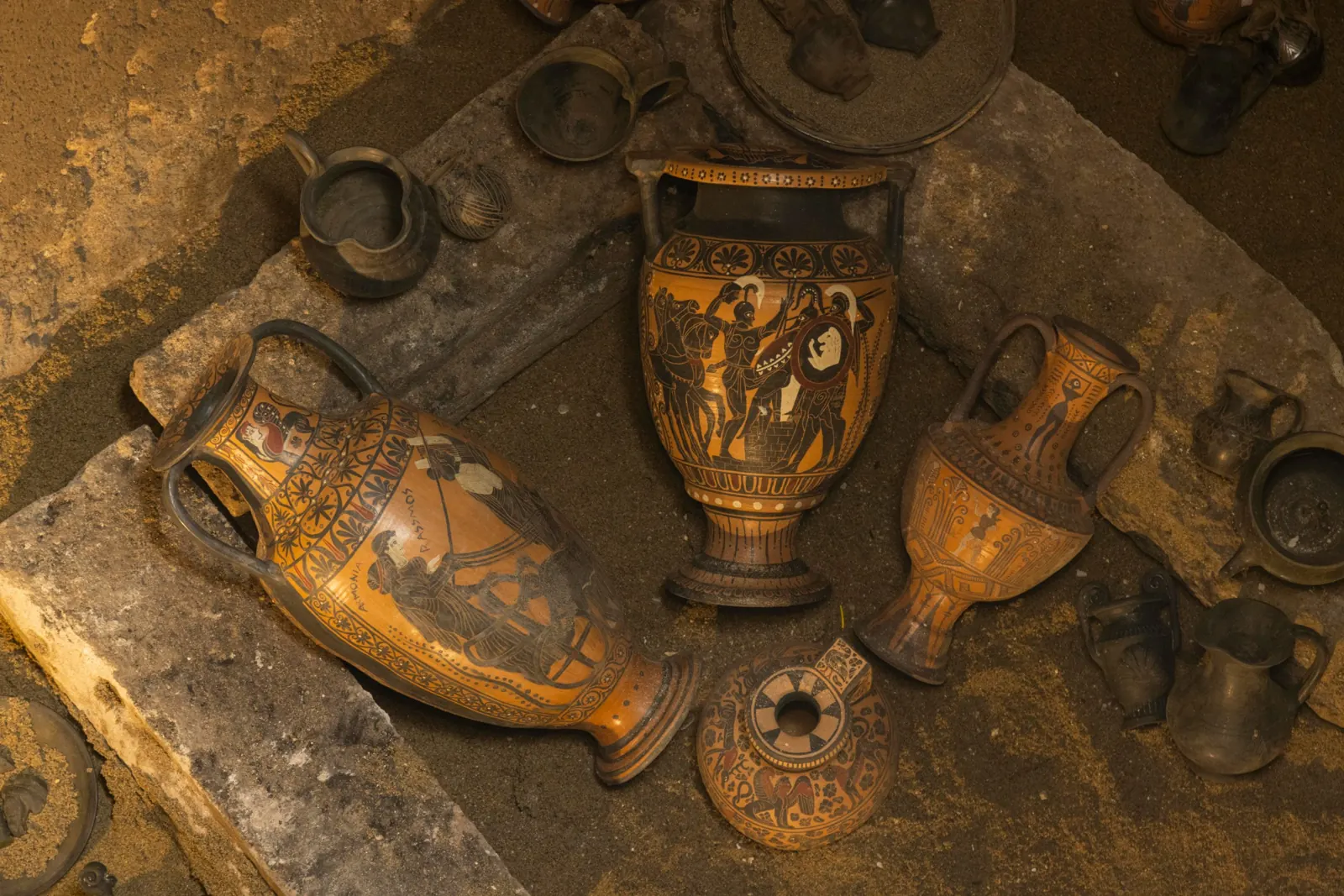
- Pottery: Greek black-figure and red-figure pottery was highly prized in Etruria and often appears in tomb goods; the Etruscans also produced bucchero, a glossy black ware.
- Stone architecture: tufa and stone were everyday materials, which is why so many buildings in Tarquinia still look the way they do.
A piece of Etruscan history beneath the floor
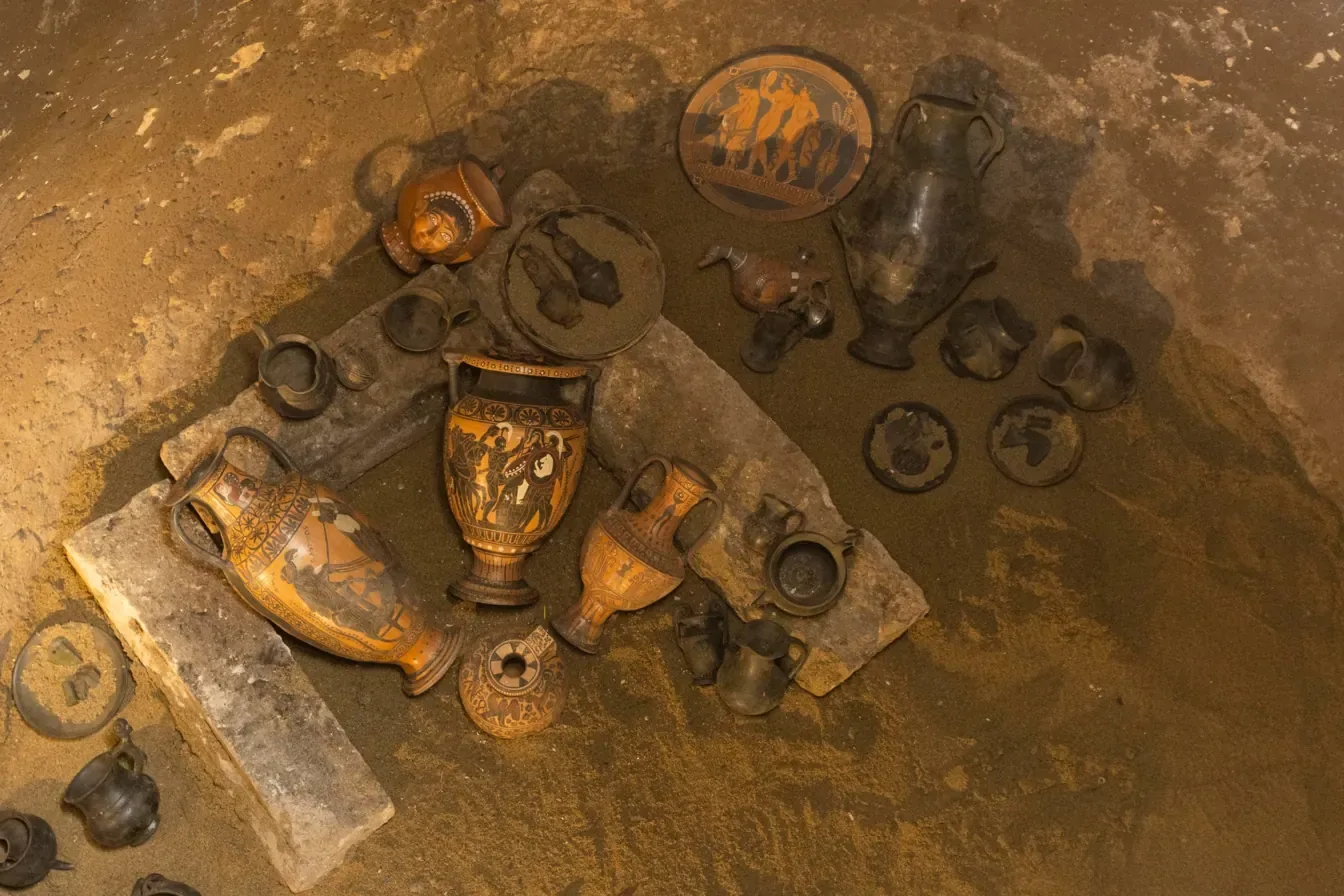
In Tarquinia you do not only visit: you can also sleep in a place with Etruscan history. In the Il Butto loft, a butto of Etruscan origin, reworked in the Middle Ages, opens into the floor: through the glass you can see amphorae, plates and grave goods, lit at every hour of the day.
Where to meet the Etruscans in Tarquinia
- Monterozzi Necropolis: the painted tombs, a UNESCO site.
- National Archaeological Museum: the Winged Horses, sarcophagi and detached tombs.
- Ara della Regina and the Civita: where the city of Tarchna stood.
- Il Butto: a butto of Etruscan origin beneath the loft's glass floor.
To plan your visit read museum and necropolis of Tarquinia and things to do in Tarquinia; to sleep here, Il Butto.
Frequently asked questions
Who were the Etruscans?
A civilisation of central Italy that flourished between roughly the 9th and 1st centuries BC, organised in independent city-states, with its own language and art, in close contact with Greeks and Phoenicians.
Where did the Etruscans come from?
The question has long been debated. The most recent research points to a local formation in central Italy, starting from the Villanovan culture.
Why is Tarquinia so important?
For its roughly two hundred painted tombs, which show Etruscan life and rituals, and for its museum, which holds masterpieces such as the Winged Horses.
Keep reading